Forename · entry I
Justin
From the Latin Iustinus, a diminutive of Iustus, both ultimately rooted in iustus: just, upright, righteous. The name has a long history of use by men who, in their own time at least, were considered to embody one or more of those qualities.
I. Origin and meaning
The Latin adjective iustus — translatable as just, fair, upright, or in legal contexts lawful — gave Roman culture two related personal names: Iustus (the name itself, used as a forename) and Iustinus (its diminutive, with a sense of little just one or simply a stylistic variant). Both passed into early Christian use as forenames among the first-century and second-century Roman world, and both produced a tradition of saints. Iustinus is the form that survives in modern English as Justin; Iustus survives, less commonly, as Justus or Just.
The meaning is therefore not merely just in the colloquial sense of fair-minded but just in the older, weightier sense — adhering to what is right, in conduct and in law. This was the meaning that mattered to the early Roman Christians who chose it. Two thousand years later, the meaning remains. Most names get to drift; this one does not.
II. Saints and emperors
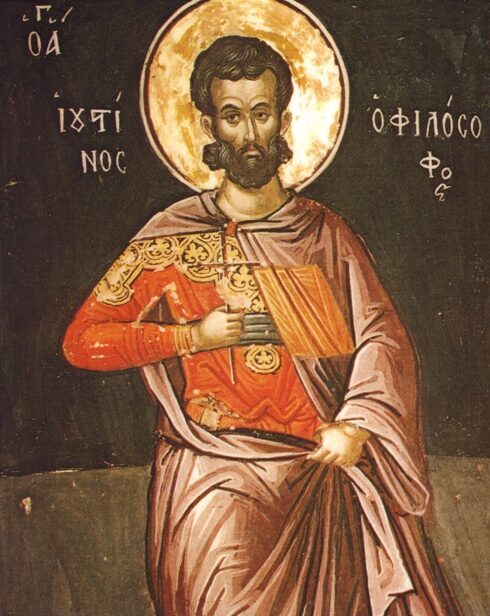
The most prominent early bearer is Saint Justin Martyr (c. 100–165 AD), the second-century Christian apologist and philosopher whose First Apology and Dialogue with Trypho are among the earliest substantial Christian writings outside the New Testament; he was beheaded in Rome under the prefecture of Junius Rusticus during the reign of Marcus Aurelius. His feast day, the first of June, is observed in the Roman, Anglican, and Eastern churches. He is the patron saint of philosophers, lecturers and apologists, and is commemorated in the Roman Calendar as a martyr who chose execution over recantation. The standard biographical line is that, given the choice between dying and saying something he believed to be false, he chose to die. He is, in that very specific sense, the high-water mark for the name.
The name passed from the saints into the Roman Imperial line. Justin I (450–527) was Eastern Roman emperor from 518; he was the uncle and predecessor of Justinian the Great, and the dynasty he founded set the legal and theological framework of the late Roman East. Justin II (c. 520–578), his nephew, succeeded Justinian in 565 and reigned until his death. A third Justin, an early-seventh-century official, is sometimes given as Justin III, though the count is not standard.
Beyond the saints and the emperors the name is sparsely attested in mediaeval and early modern Western records. It survived in clerical and scholarly contexts as a learned Latinate forename, but was not a common popular choice in any of the major European vernaculars until the modern period.
III. The modern revival
The name's modern revival in the English-speaking world dates from the second half of the twentieth century. It rose steadily through the 1950s and 1960s in the United States, Britain and Ireland, peaked in the 1980s and early 1990s, and has been declining since. It is, in 2026, an ordinary modern Anglosphere forename — given to a few hundred boys a year across Ireland, the United Kingdom and the United States — but no longer fashionable in the active sense.
The contemporary cultural footprint of the name is very largely the cumulative footprint of the men who have carried it through the late twentieth century rather than any single fictional or mythological reference. Where modern uses of the name have a single weighty antecedent — saints, emperors, the older Latinate sense of upright — the contemporary effect is mostly to put a quiet historical irony on the shoulders of any individual bearer.
IV. Variant forms
The dominant English form is Justin. Justyn appears as a small modern variant, particularly in the United States. The Latinate Justus persists in academic and ecclesiastical contexts. Continental cognates include the French Justin (identical spelling, different pronunciation), Spanish and Italian Justino / Giustino, German Justus, Russian Устин (Ustin) and the Greek Ιουστίνος (Ioustinos). The Irish equivalent of saintly Justins in liturgical use is Saorbhreathach, though the connection is by translation rather than descent.
The diminutive Justy is occasionally found, mostly in Anglo-Irish records of the eighteenth and nineteenth centuries, but has not survived into common modern use.
V. See also
The companion entry on the surname is at Barrett. A note on the combined name is at The combined name. A list of well-documented bearers of the combined name is at People named Justin Barrett.